
General Enquiries: 020 7561 1786 or Email: info@credit-union.coop      |       CU Loan Repayment Issues Only: 020 3763 8397  or Email: loansupport@credit-union.coop

Beware of online access fraud

More than £50 million was lost last year to scams where victims are tricked into handing over control of their computer or smartphone to criminals.

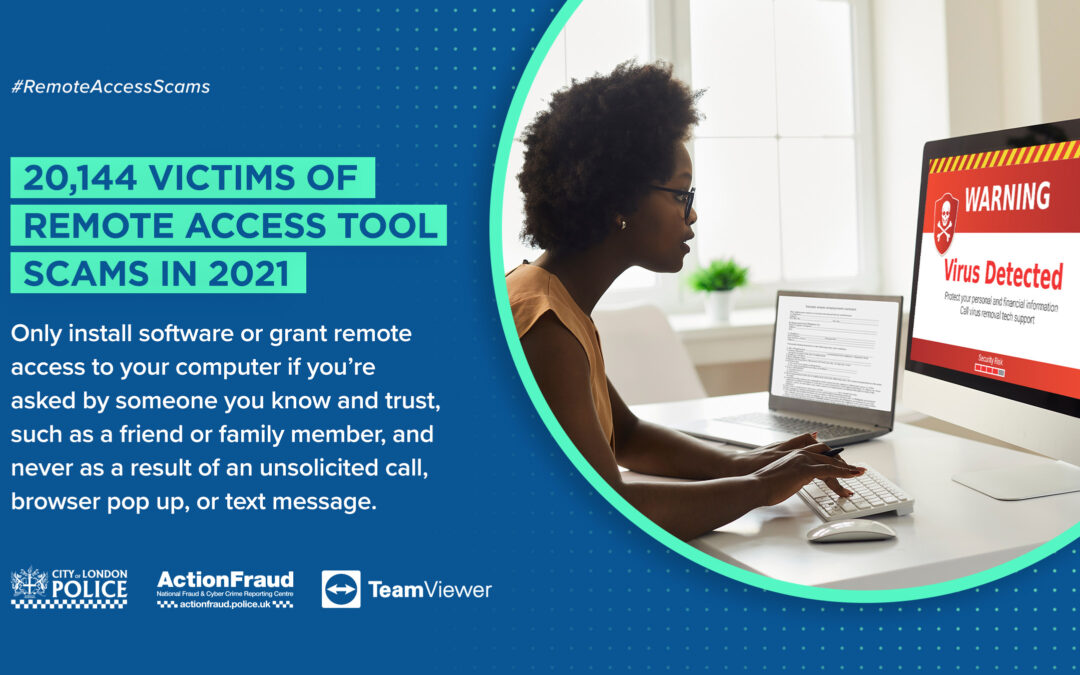
New data from Action Fraud, the national reporting centre for fraud and cybercrime, reveals that 20,144 people fell victim to scams where they were persuaded to grant criminals remote access to their device. Victims reported losing a total of £57,790,384 – an average loss of £2,868 per victim.

Remote access tool scams will often begin with a browser pop-up saying that your computer is infected with a virus, or with a call from someone claiming to be from your financial provider saying that they need to connect to your computer in order to cancel a fraudulent transaction on your account.

Criminals will try to persuade the victim to download and connect via a remote access tool, which allows the criminal to gain access to the victim’s computer or mobile phone. If the victim allows the criminal connection via the tool, they are able to steal money and access the victims banking information.

Detective Chief Inspector Craig Mullish, from the City of London Police, said: “While remote access tools are safe when used legitimately, we want the public to be aware that they can be misused by criminals to perpetrate fraud. We often see criminals posing as legitimate businesses in order to trick people into handing over control of their computer or smartphone.

“You should only install software or grant remote access to your computer if you’re asked by someone you know and trust, such as a friend or family member, and never as a result of an unsolicited call, browser pop-up or text message.”

In one case, a victim lost over £20,000 after they received a call from someone claiming to be from Sky stating that there was a problem with their Sky box. The suspect persuaded the victim to download a remote access tool to their device which enabled the suspect to access the victim’s online banking and make a number of transfers to an account under the suspect’s control.

Another victim lost over £1,000 after they received a call from someone claiming to be from Amazon stating that they were processing a payment for an Amazon Prime membership. The victim told the suspect that they hadn’t subscribed to Amazon Prime but clicked on a link provided by the suspect to cancel the membership. The link downloaded a remote access tool to their device which enabled the suspect to access the victim’s online banking and empty their account.

Credit Union Chief Executive Martin Groombridge said: “Online fraud is a growing problem, and it is all too easy to be scammed by persuasive criminals posing as genuine businesses. The Credit Union, like all legitimate businesses, will NEVER call you out of the blue asking you to download software to your computer or smartphone and we will NEVER ask you for remote access to your device.”

How to protect yourself online

  • Only install software or grant remote access to your computer if you’re asked by someone you know and trust, such as a friend or family member, and never as a result of an unsolicited call, browser pop up, or text message.
  • Remember, a bank or service provider will never contact you out of the blue requesting remote access to your device.
  • If you believe your laptop, PC, tablet or phone has been infected with a virus or some other type of malware, follow the NCSC’s guidance on recovering an infected device.
  • Protect your money by contacting your bank, credit union or financial provider immediately on a different device from the one the scammer contacted you on.
  • Report it to Action Fraud on 0300 123 2040 or via police.uk.

Action Fraud also advises that the public follow the advice of the Take Five to Stop Fraud campaign to keep themselves safe from fraud.

  • Stop: Taking a moment to stop and think before parting with your money or information could keep you safe.
  • Challenge: Could it be fake? It’s okay to reject, refuse or ignore any requests. Only criminals will try to rush or panic you.
  • Protect: If you think you’ve been a victim of fraud, contact your bank, credit union or financial provider immediately and report it to Action Fraud online at police.uk or by calling 0300 123 2040.

Previous

Next

How We Decide to Whether to Offer a Loan – The Basics

The Credit Union’s primary objective is to help members avoid or escape from debt by promoting a culture of saving. When we offer loans, we only do so if the borrower agrees to save a little while they repay. The establishment of a savings habit is proven to reduce the harms and risks of long-term borrowing becoming problem debt. Basically, when we get a loan application our decision is based on the following two principles:

1. Do we trust the applicant to repay the loan?

2. Can the applicant afford the loan repayment

This guide is designed to help members understand our thinking so you can best prepare if you should need to apply or re-apply for a loan.

1. Key Points in Our Assessing Trust of the Applicant

a) Has the applicant started saving? The money we lend is members savings so, especially at busy times, we have to give priority to loan applications from members who have made at least one savings payment. That first payment is good evidence that you are a real person and helps us confirm identity.

b) Proper Proof of ID & Address? What forms of proof of identity and address has the member provided? If you are able to connect your bank account through ‘open banking as art of the loan application process it a good way of proving ID. First time loans may be required to use online Open Banking.

c) Previous Borrowing History. Has the applicant borrowed and repaid us previously? Previous good repayment record supports any application.

d) Did the applicant inform us of other money owed? Failure to list all debts in the application process is likely to result in the loan application not being approved. It suggests that the applicant is either not in control of their money or not being completely honest with us and in either case we cannot put our members savings at risk by lending. Credit Reference Agency checks are used to show us what money is owed and to whom.

e) Is the member sensible with money? When we review the bank transactions of the loan applicant, we often see patterns of expenditure that suggest the applicant is not taking a sensible approach to expenditure. Changes in the way they manage their finances would suggest that the loan would not really be necessary. We want to help people be in control their finances and do not want to lend members savings to people who are not deemed sensible with the way they spend. This may be things like gambling, excessive shopping and/or eating out/takeaway food deliveries.

f) Always be ‘up front’ in your application. Honesty pays. We do not judge.

2. Key Points in Our Assessing Affordability for the Applicant

a) Is this loan in the member’s best interest? The value of the loan application in comparison with your income is a key measure of affordability. The loan interest members pay on loans pays our staff salaries, but we are not out to profit from you, rather we want members to borrow less over time and take control of their finances.

b) Positive Bank Balance at Month End? Is there money left in the members bank account at the end of the month that would be sufficient to cover the loan repayment if approved? If not, the member must explain how the loan would become affordable, for instance, by reducing expenditure in other areas.

c) Is the applicant struggling with existing debts? When we review the bank transactions of the applicant we can see income and expenditure. If the loan applicant tells us how the loan will clear other debts and reduce their expenditure this will help us understand affordability.

d) Is the purpose of the loan considered sensible? If the applicant is not paying essential bills such as mortgage or rent then a loan for a car or holiday is likely to be unwise and unaffordable.

e) Has the applicant fully explained why they need to borrow? Always feel free to email or call us explaining the circumstances that mean you need to borrow. The reasons for needing to borrow are complex, but being honest and explaining the circumstances can often help the ordinary humans on the Loans Team at the Credit Union to be able to assess trust and affordability. You briefly explaining your thinking about affordability gives us confidence that you are thinking sensibly about money, and sometimes allows us to suggest alternatives that may well be in your best interest.

f) Is the loan to clear other more expensive debts? Credit Reference Agency checks are used to show us what money is owed and to whom. If your loan application is to pay off other debts, stop and list every one of those debtors.Work out the cost of each. Consider clearing one or two at a time if its your first Credit Union loan. Pick them off one or two at a time, the most expensive first.

g) Has the applicant stopped to think about affordability? The ‘Your Money’ section of our website provides access to a budget planner which, if used and shared, gives us good evidence of affordability. Particularly helpful for loan applicants in financial stress. We hope this gives you an idea of how we decide yes or no to loan applications. The decision is by one or more other credit union members on our Loans Panel. We hope this helps you understand our thinking so you can best prepare if you should need to apply or re-apply for a loan.